Eliminating Lead Adulteration of Turmeric in Bihar State, India
Project Overview
Active
Country
India
Pollutant(s)
Lead
Date
2024-2026
Funder(s)
American Spice Trade Association (ASTA)
Partner(s)
Government of Bihar: Food Safety and Standard Authority of India; Dept. of Food & Safety Bihar, Dept. of Health (IDSP) State Health Society Bihar, Dept. of Forest, Environment & Climate Change; Civil Society Organizations; local spice traders and vendors
Core Activities
Advocacy & Awareness, Institutional Strengthening
Industry
Spice
Pathway
Ingestion
Source
Spices
Project Objectives
The project aims to significantly reduce turmeric adulteration, and therefore lead exposure, in Bihar, India, an epicenter for the practice of adding toxic lead chromate to the spice. Through the development and dissemination of awareness materials, guides, and media stories; stakeholder engagement and advocacy; and technical training of key officials and sharing of information with vendors, buyers, and consumers about the dangers and legal penalties of lead adulteration, this problem can be solved.
Pure Earth aims to reduce human exposure to lead in Bihar in Northern India via two objectives:
- Objective 1: Increased knowledge of target populations about lead exposure
- Objective 2: Strengthened government capacity to improve & enforce regulations for exposure reduction
Through government capacity-building, policy advocacy, and market interventions, we aim to eliminate lead adulteration in the turmeric supply chain in Bihar, paving the way for a safer and healthier future for the residents of Bihar and validating activities that can be replicated in other affected areas of India and beyond.
Background
In recent years, a variety of independent assessments has found that Northern India, specifically Bihar, has the highest prevalence of lead poisoning in the country. In 2022, Pure Earth and its partners conducted a representative blood-lead level (BLL) survey in the State, testing 699 children aged 1-5 and 55 pregnant women. The findings were alarming, revealing that 91% of kids’ BLLs exceeded 5 μg/dL, the WHO’s recommended threshold for medical intervention. The median BLL, 7.8 μg/dL, is approximately 8X higher than the US average. The Institute for Health Metrics and Evaluation estimates that nearly 19 million Bihari children ages 0-14 have BLLs indicative of lead poisoning. Previously, in 2020, Pure Earth had already documented that 87% of the children in Patna, the capital of Bihar, exceeded the WHO BLL threshold.
Turmeric as a main contributor to lead poisoning
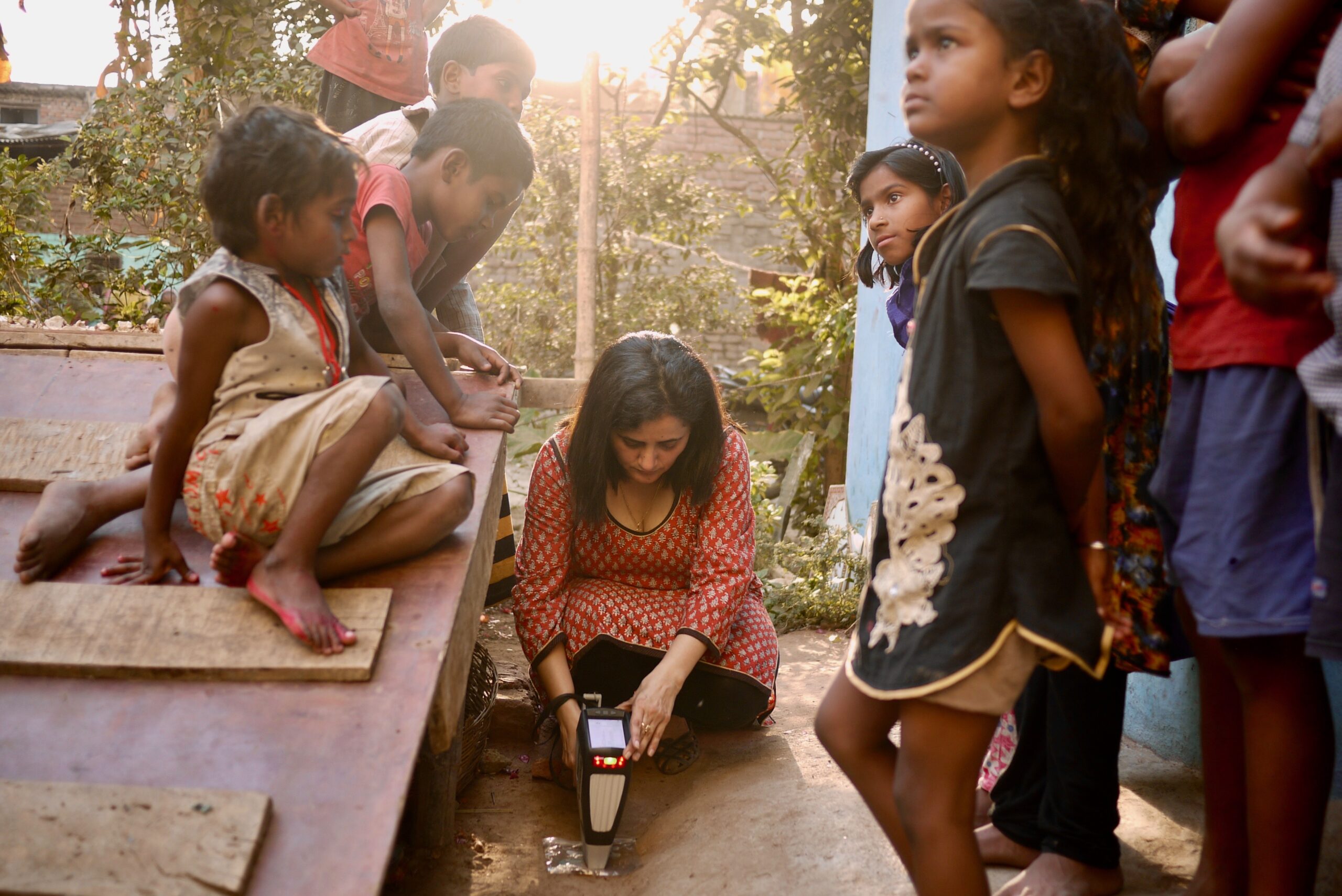
Previous work in the Bihar State and other parts of South Asia has indicated that Bihar is an epicenter for turmeric adulteration with lead chromate. Parallel to BLL surveys between 2020 and 2023, source assessments were conducted. In 2020, 135 homes were assessed showing that 75% of samples exceeded 10 ppm (parts per million), with a maximum of 5,773 ppm. In 2022/2023, a total of 152 homes in Bihar were surveyed with results indicating that turmeric samples had a median lead concentration of 30 ppm with a maximum of 4,139. The international standard for lead in spices tends to be 2 ppm but the permissible limit in India is still 10 (Food Safety and Standards Authority of India, 2011).
Additionally, for the last five years Stanford University and Pure Earth have been carrying out supply chain analyses and spice adulteration testing, revealing high concentrations of lead in spices. The testing was done through visits to commercial hubs, specifically in Bihar. In May 2023, Pure Earth carried out a Rapid Market Screening project in three cities of Uttar Pradesh; where 70% of spice samples had elevated levels of lead as per the international standard of 2ppm.
Ongoing investigations have identified hubs of adulteration in Bihar. Evidence suggests that lead chromate is introduced to turmeric roots by wholesale traders at central markets. These contaminated roots are then distributed throughout the state. Therefore, we believe that focusing intervention efforts on central hubs in Bihar will yield maximum impact with the potential for a ripple effect that extends throughout the Northern India region. Elevated lead levels in turmeric, ranging from 50 to 500 times the permissible limit, have been detected in every assessed city of Bihar (a total of 20 cities to date).
India is the world’s leading producer and exporter of turmeric, providing 80% of the global supply and approximately 70% of the US supply. Lead-contaminated Indian turmeric has not only led to recalls in the US in the past but has also been linked to cases of pediatric lead poisoning in the country. As long as lead continues to find its way into Indian turmeric, it poses a global threat and a reputational risk for the spice industry as a whole.
Last Updated:
04/22/25