Overview
SCALE is an eight-year initiative running from 2026 through 2033 that aims to reduce lead poisoning in countries that are home to half of all children and adolescents with elevated levels of lead in their blood.
Led by Pure Earth with a consortium of partners, SCALE works with governments in high-burden countries through three primary steps: 1) revealing the prevalence, severity, and distribution of exposure; 2) pinpointing and prioritizing the major sources of exposure; and 3) eliminating or mitigating those sources through regulation and enforcement, behavior change, and remediation of polluted sites. SCALE will also accelerate progress beyond those countries by consolidating global lead exposure data and developing analytical tools that make interventions more effective.
SCALE was developed with and is supported by The Audacious Project, a collaborative funding initiative housed at TED, together with a community of donors.
Lead Poisoning: A Primer
The Problem
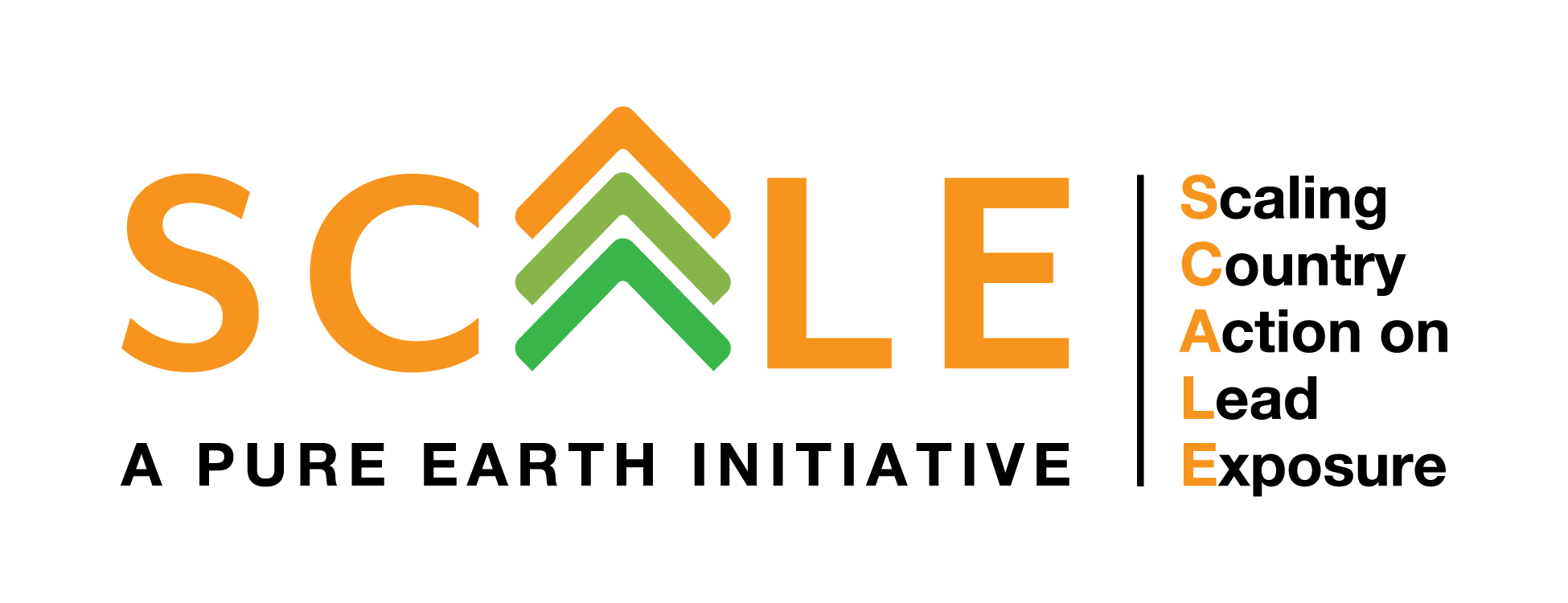
Nearly one billion children have blood lead levels above the World Health Organization’s threshold for intervention. That is 1 in 3 children globally, and 1 in 2 in low- and middle-income countries. This is ten times the lead poisoning rate recorded in Flint, Michigan, at the peak of the crisis that drew international attention.
The consequences reach across nearly every measure of human wellbeing:
- Global health. Lead exposure contributes to an estimated 3.5 million premature deaths each year, roughly 6% of all annual deaths. That is more than HIV, malaria, tuberculosis, measles and all active wars combined. Most of these deaths are from heart attacks and strokes, because lead stored in the body raises blood pressure and damages blood vessels for decades after exposure.
- Maternal and newborn health. A woman’s bones can store lead for decades. Pregnancy releases it into her bloodstream, where it crosses the placenta, so a child can be poisoned before birth. Lead is linked to gestational hypertension, preterm birth, low birth weight and stillbirth.
- Education. Lead attacks the developing brain, costing the average child in a low- or middle-income country about four to six IQ points. Across a population, that shift halves the number of gifted children with an IQ above 130 in a country and roughly doubles the number with intellectual disability and an IQ below 70. Lead is estimated to account for 20 percent of the learning gap between children in low- and high-income countries.
- Economic development. Premature deaths and lost IQ cost an estimated $6 trillion a year, nearly 7% of global GDP. That puts lead on par with outdoor and household air pollution combined, and makes it costlier than unsafe water and sanitation.
Despite the scale of the harm, most governments have no national data describing how widespread lead exposure is in their country or which sources are driving it. Fewer than 5 percent of low- and middle-income countries have conducted a nationally representative blood lead survey among children. Global modelled estimates establish that the problem exists and suggest its severity, but they rarely move a health minister and they aren’t granular enough to design a strategy around. Governments act on their own data, and a national survey can inform a response in a way that estimates cannot.

The Solution
The World Bank ranks lead poisoning prevention among the most cost-effective investments in international development, with returns ranging from tens to hundreds of dollars for every $1 invested, and more in some cases. By simply identifying the major sources of lead exposure and working with the national government to ban them, organizations have protected millions of children. A few examples:
- China: After China banned leaded gasoline in 2000 and tightened industrial controls, the share of urban children with blood lead above the World Health Organization threshold fell from 74% in 2002 to 28% in 2012.
- Bangladesh: Bangladesh: Enforcement against lead-adulterated turmeric cut contaminated market samples from 47% to zero between 2019 and 2021.
- Vietnam: After an informal battery recycling site in Dong Mai village was remediated, children’s median blood lead fell by 67% within a year, from 40.4 to 13.3 micrograms per deciliter.
Preventing Lead Poisoning at SCALE
SCALE is founded in the belief that governments must be the ultimate owners of this issue and its solutions. Only they can regulate a product, enforce a standard, or keep a surveillance system funded year after year, so most activities under SCALE run in collaboration with governments or directly through government agencies. When a government owns the data, the plan, and the skills, a national response can outlast our presence.
Working this way, SCALE operates in countries that are home to more than half of the world’s lead-poisoned children, roughly 550 million with elevated blood lead. In each country, we help governments measure the problem, identify what is causing it, and act on the findings, then build the institutions that keep the work going after we leave.
To accelerate action beyond those countries, SCALE is also building the LEAD Hub (Lead Exposure and Action Data Hub) with the Institute for Health Metrics and Evaluation (IHME) and the Partnership for a Lead-Free Future (PLF). The Hub will consolidate blood lead and exposure-source data from around the world and link it to proven interventions, so any government, implementer, researcher, or donor can see what is known about a country and what to prioritize.
How We Work In-Country
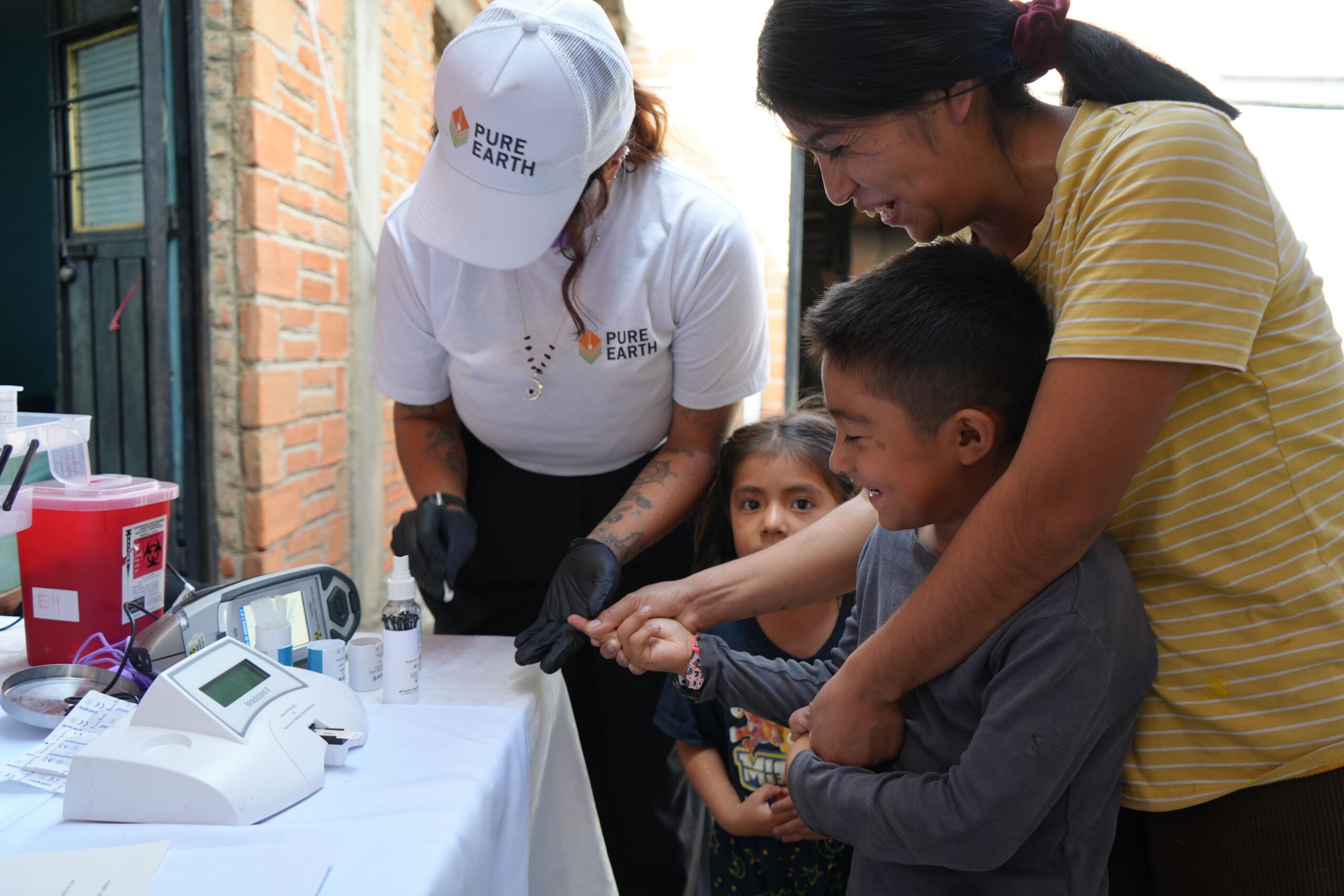
Our model to reduce childhood lead poisoning has three primary steps:
- Reveal the crisis. The first step establishes how widespread and severe exposure is, through a nationally representative blood lead survey owned by the government and designed with partners who bring deep biomonitoring expertise. SCALE funds several of these surveys directly. Where other donors are financing the survey, we concentrate our own funding on the steps that follow.
- Pinpoint the causes. The second step identifies and prioritizes causes of exposure. We carry out in-depth exposure source assessments that test everyday items and environmental media in homes, markets, and communities, and produce a prioritized account of what is driving exposure. Sources vary widely between countries because cultures, diets, industries, regulations, and habits vary, so this step is critical for designing effective and efficient interventions.
- Eliminate sources of exposure. The third step acts on the evidence: the government, Pure Earth and other partners develop a national strategy targeting priority exposure sources, and we support implementation through regulation, industry engagement, market enforcement, remediation, and public information.
Communications and government ownership run alongside all three steps. Communications planning begins during survey design rather than after results arrive, so that the relationships and materials exist at the moment the data lands. Government ownership is built from the first meeting rather than handed over at the end.
Countries enter at different points along these three steps depending on what data already exists and what other actors are doing. We transition out when lead exposure shows a sustained decline and when monitoring and mitigation efforts are institutionalized well enough for the country to continue making progress independently.

How Georgia Got Lead Out of Its Spices: A Case Study
In 2018, a national survey conducted by the Georgian government with UNICEF found that 41% of children aged two to seven had elevated blood lead, rising to 85% in some western regions. Pure Earth worked with national health authorities to test soil, dust, paint, water, spices, toys and cookware, and identified spices as one of the primary sources, traced to importers and wholesalers adding lead chromate to brighten color.
The government acted on its own data. It tightened food safety rules, required sealed packaging, strengthened oversight, and built laboratory capacity to enforce the new rules, while a national awareness campaign shifted consumer demand and put pressure on the supply chain. By 2022, elevated lead appeared in just 1% of more than 700 spice samples tested. In the hard-hit city of Poti, children’s average blood lead fell from 7.5 to 2.1 micrograms per deciliter between 2018 and 2023. Georgia launched a national environmental health surveillance system for lead in 2023, and Pure Earth exited in 2025.
Our Objectives
Pure Earth’s SCALE initiative has three objectives: build national capacity and ownership, reduce exposure from priority sources, and accelerate progress globally.
- Build national capacity and ownership
Evidence is what makes action possible, but capacity is what makes it last. Alongside the survey and source assessment, we equip laboratories to test for lead, train staff who can design a survey and interpret its results, and work with agencies to build a national strategy. From there, the work extends to inter-agency working groups, standards, clinical guidance, enforcement capacity, routine monitoring, and the domestic budget lines that let a country keep going without us.
- Reduce exposure from priority sources
This objective is where exposure actually falls. Success means measurably less lead in the products and environments children encounter and less lead in their bodies, sustained by rules the government enforces rather than by our presence. Public information plays a part too, helping families reduce their own exposure in the years before enforcement reaches everyone.
- Accelerate progress globally
Despite SCALE’s ambitious geographic reach, hundreds of millions of lead-poisoned children live outside the countries where we work directly. We will accelerate global progress beyond our reach by funding work that makes lead programs everywhere more efficient and effective, whether or not we are involved. The LEAD Hub described above is the largest of these. We will also fund global policy advocacy on lead, research that fills gaps holding the field back, and tools and technical standards any implementer can use.
Where We Work
Our commitment is to work in countries that together are home to more than half of the world’s lead-poisoned children. Countries will be selected on a rolling basis as evidence improves and as we see where Pure Earth and its partners can add the most value. This section describes our current portfolio of countries and how we select new ones.
Our Current Portfolio
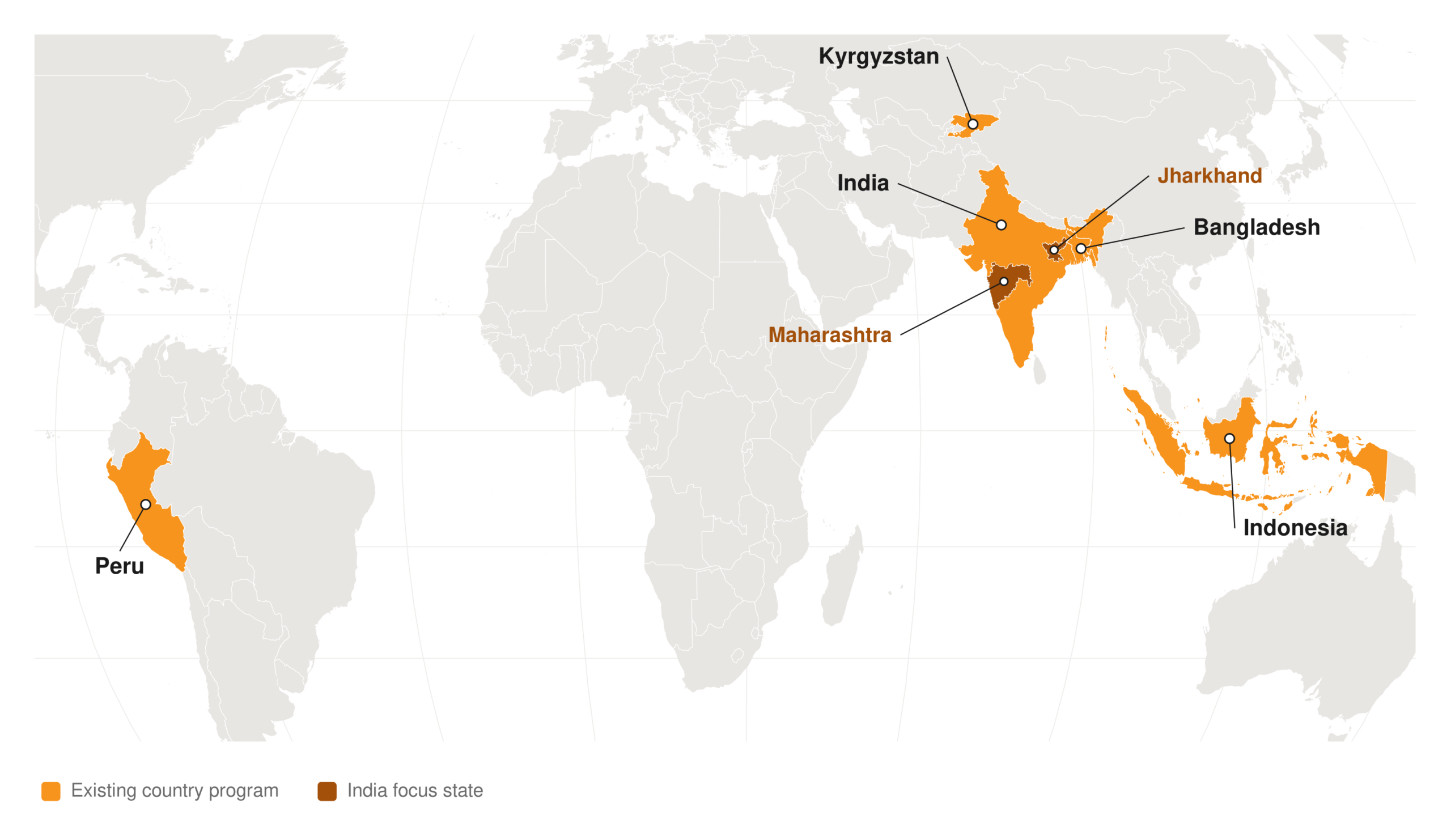
We already run country programs in Bangladesh, Indonesia, Kyrgyzstan, Peru, and India, where SCALE funding will go mostly toward pinpointing sources of exposure and reducing them. In India, the SCALE Initiative will focus on two states: in Maharashtra we are building on existing work, and in Jharkhand we are starting with a blood lead survey. In countries where little lead work has been done, SCALE will either fund a nationally representative blood lead survey, or will fund source assessment and exposure mitigation activities where another group funds the survey. More countries will be added over time.
How We Select New Countries
We select countries on the basis of two criteria: burden and tractability. Our full prioritization framework can be found here.
Burden relates to the scale of the issue in a given country. We index for this primarily by looking to the estimated number of people under age 20 with blood-lead levels above 5 ug/dL. These estimates are available at leadpollution.org and often originate from the IHME’s Global Burden of Disease analysis. In addition to the number of children with unsafe levels of lead in their blood, we may also consider the degree of lead exposure (i.e., average blood-lead level) within the population. However, we weigh the number of children affected in a country more heavily than the severity of exposure based on a long-standing observation in public health that most preventable harm comes not from the most severely affected individuals but from the far larger number of people at moderate risk.
Tractability relates to how feasible it will be for the country to reduce lead exposure. Tractability is harder to measure directly than burden, so we use a few proxies. For example, we may look to the prevalence of lead pollution within a population – all else equal, a country where 70% of the population is exposed to unsafe levels of lead may be easier to remediate than a country where 10% of the population is, since there may be more low-hanging fruit when prevalence is higher. Beyond prevalence, we also look to government commitment, the regulatory environment, governance and security conditions, local partners, and whether workable interventions exist for the sources that dominate there.
It would be misleading to present a country list as the output of a formula. Our country selection also reflects existing relationships and infrastructure, coordination with other organizations to avoid duplication, and opportunities to build on work by other partners.
Our Partners
UNICEF and Vital Strategies — Conduct blood lead surveys and bring deep biomonitoring and public health expertise, while supporting the longer work of institutionalizing biomonitoring within national systems.
Universities, civil society organizations, and government scientists — Contribute to source assessments.
Specialists in priority exposure sources — Support mitigation efforts with expertise in the sources that have emerged as priorities.
Institute for Health Metrics and Evaluation and the Partnership for a Lead-Free Future — Collaborate on the development and management of the Lead Exposure and Action Data Hub.
We expect to name additional partners as the initiative grows.
How We Measure and Report Impact
The SCALE initiative has different targets for its total reach and for its direct beneficiaries. Reach is the number of children with elevated blood lead living in the countries and states where we work, and we aim to reach 550 million. Direct beneficiaries are the subset whose reduction in exposure we can measure or credibly estimate, for example children in households using a product whose lead content has fallen, or who live near a contaminated site that has been remediated. Across that group, we aim for an average of at least 20 percent reduction in cumulative population blood lead: the number of children exposed multiplied by their average blood lead level. Working in that unit rather than averaging percentages lets each population of direct beneficiaries count in proportion to its size and its starting blood lead level, so results from different countries and sources can be added together.
We evaluate progress at three levels, each a step closer to the outcome that matters most, less lead in children’s bodies, and each more costly to measure and more conclusive than the one before it.
Activities and policy changes. We track new laws, regulations, and enforcement efforts covering major sources of lead exposure in every country program. This is the earliest signal of progress and the easiest to verify, but on its own it does not show that exposure has fallen. Wherever possible, this tracking aligns with the Partnership for a Lead-Free Future’s Global Framework indicators, so the same data serves both our reporting and a government’s.
Lead in exposure sources. Market surveys measure the amount of lead in major sources of exposure before and after policy change, to assess whether new rules are reducing lead content in consumer products and environmental media. This is the main body of evidence for the program, and we track it for every priority source. We convert measured reductions at the source into estimated reductions in children’s blood lead using validated models such as the US Environmental Protection Agency’s All Ages Lead Model. The children whose blood lead we can estimate falling this way are the ones we count as direct beneficiaries.
Lead in people. Measured change in blood lead levels from pre- and post-intervention surveys is the gold standard. Repeat nationally representative surveys are expensive and we do not have budget for both baseline and endline national surveys, so direct before-and-after measurement is available for some interventions but likely not most. These surveys measure young children, typically aged one to five, because that is the period of greatest developmental vulnerability and the age range a nationally representative survey can practicably cover. The population we reach is broader, since lead harms development across childhood and adolescence and source-level interventions do not distinguish by age.
Across all three levels, we count only our share of what would not have happened without us. Where a government’s own enforcement delivers a result, we claim a contribution rather than the whole. The goal is shared across funders and counted once, results are published as ranges that narrow as evidence accumulates, and we report what did not work as openly as what did.
Resources and Funding Needs
Funding Other Organizations
Some SCALE funding will go to other organizations not yet named as partners. We expect to fund partners where another group is better placed to lead on a particular exposure source or geography, or where we want to move faster than we can staff ourselves. Most of this will support source assessment and mitigation in SCALE countries, with a smaller share for work that accelerates progress more broadly. We will publish details on what we fund and how to apply when the process opens.
Additional Funding Needs
SCALE is budgeted at approximately $154 million through 2033. That figure includes roughly $45 million of work Pure Earth carries out under Bloomberg Philanthropies’ Lead Poisoning Prevention Initiative. Approximately $128 million is secured, leaving $26 million still to raise.
To support SCALE, you can give at pureearth.org/take-action, or contact Carol Sumkin, VP of Development, at carol[at]pureearth.org.
About The Audacious Project
Launched in 2018, The Audacious Project is a collaborative funding initiative dedicated to supporting bold ideas with the potential to change the world. Housed at TED and powered by the belief that ideas change everything, Audacious leverages a global network of visionary social entrepreneurs and funders to support bold solutions to the world’s most urgent challenges. Audacious is issue-agnostic and supports grantees to balance audacity and achievability for lasting, systemic impact. Since 2018, Audacious has catalyzed more than $7 billion for 70 projects, demonstrating what’s possible when we dream bigger and act together. The funding community includes respected donors and philanthropists including ELMA Philanthropies, Emerson Collective, MacKenzie Scott, Pivotal Ventures, Reed Hastings and Patty Quillin, Skoll Foundation, Valhalla Foundation and more.
