



As with all fights for public health, the campaign to raise awareness and limit exposures to lead is ever evolving. It has most recently been confronted with a new study that has finally confirmed that vapes and e-cigarettes are just as bad, if not worse, than traditional cigarettes when it comes to exposures to lead and other toxic heavy metals.
The new study, conducted by researchers at the University of California, Davis, found that some disposable e-cigarettes emit up to 15.4 μg of lead in the first 200 puffs alone—a level of exposure equivalent to smoking up to 19 packs of cigarettes in a single day. The study findings also show that the brands of e-cigarettes that tend to be popular among adolescents emit more metallic compounds than either traditional cigarettes or other types of e-cigarettes.
While cigarettes and secondhand smoke are not the primary source of lead exposure, they are a notable factor, and the successful regulation of tobacco products was a big win in the fight against lead. Despite many decades of work and countless laws, regulations, and public initiatives to control tobacco use, the upswing of vapes in the market has largely brought back the public health threat of “smoking” nicotine. Moreover, the bright colors and candy flavors of modern vapes are advertised to younger people and have put an entirely new generation at risk.
Regulation of tobacco has had a meaningful impact on the blood lead levels around the world, especially through the reduction of secondhand smoke exposures. The rising prevalence of vaping could set back this important aspect in the reduction of lead exposure, though the exact extent of this impact is yet to be determined.
Among a laundry list of negative health impacts, cigarettes have long been associated with problematic exposures to lead and other heavy metals, including aluminum, cadmium, chromium, mercury, and nickel. The new study from UC Davis reveals that many of the same heavy metals are found in e-liquids, heating elements, and battery components of various popular e-cigarette brands. Lead in particular was found at high concentrations in the coil sheaths and battery connectors of the studied devices.
The UC Davis study reveals that, when it comes to vaping, the cancer risks from nickel and antimony, and non-cancer risks from lead and nickel all exceed safety thresholds. At concentrated levels (as found in many popular vapes), respiratory exposure to these elements can increase the likelihood of serious health effects, including cardiovascular, renal, and respiratory diseases, as well as neurotoxicity and lung cancer. “These findings highlight critical gaps in e-cigarette regulation, characterization, and enforcement, with implications for public health,” the study states.
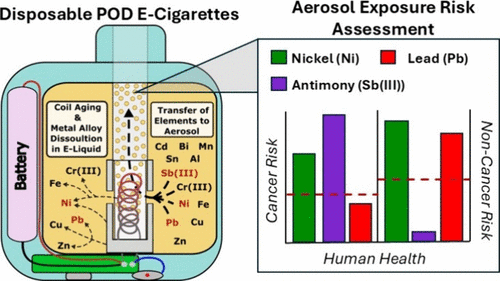
Image courtesy of UC Davis “Elevated Toxic Element Emissions from Popular Disposable E-Cigarettes: Sources, Life Cycle, and Health Risks” study.”
Modern e-cigarettes have become increasingly popular and readily available over the past several decades. This has escalated into what is widely recognized as an emerging epidemic among teens and young adults. The World Health Organization estimates that, globally, nearly 10% of youths 13-15 years old use vapes. Other estimates have put this number as high as 33% in some countries. Cigarettes, and increasingly vapes, are largely ubiquitous around the world and across cultures and age groups, making this truly an issue of global health.
The first decades of the public health fight against tobacco were set back by a lack of “convincing” evidence. Despite a well-established general recognition that smoking causes lung cancer, it took years of research and some nearly irrefutable studies to gain enough momentum to enact high level regulations of tobacco. Similarly, for a number of years now there has been substantial anecdotal evidence that vaping (especially among teens and young adults) is resulting in a range of health issues. Perhaps new studies such as the one from UC Davis, and more that are likely to follow soon, will offer the same sort of unignorable evidence that will finally prompt stronger actions to control the vaping epidemic.
As part of the Global Lead Program, Pure Earth advocates for public awareness of lead in consumer products and works to empower the global community to take action in preventing lead exposure in all forms. New and innovative research is essential to engaging public dialogue and keeping the conversation moving forward. Learn more about the Global Lead Program and Pure Earth’s advocacy at https://www.pureearth.org/global-lead-program/strategy-and-approach/