
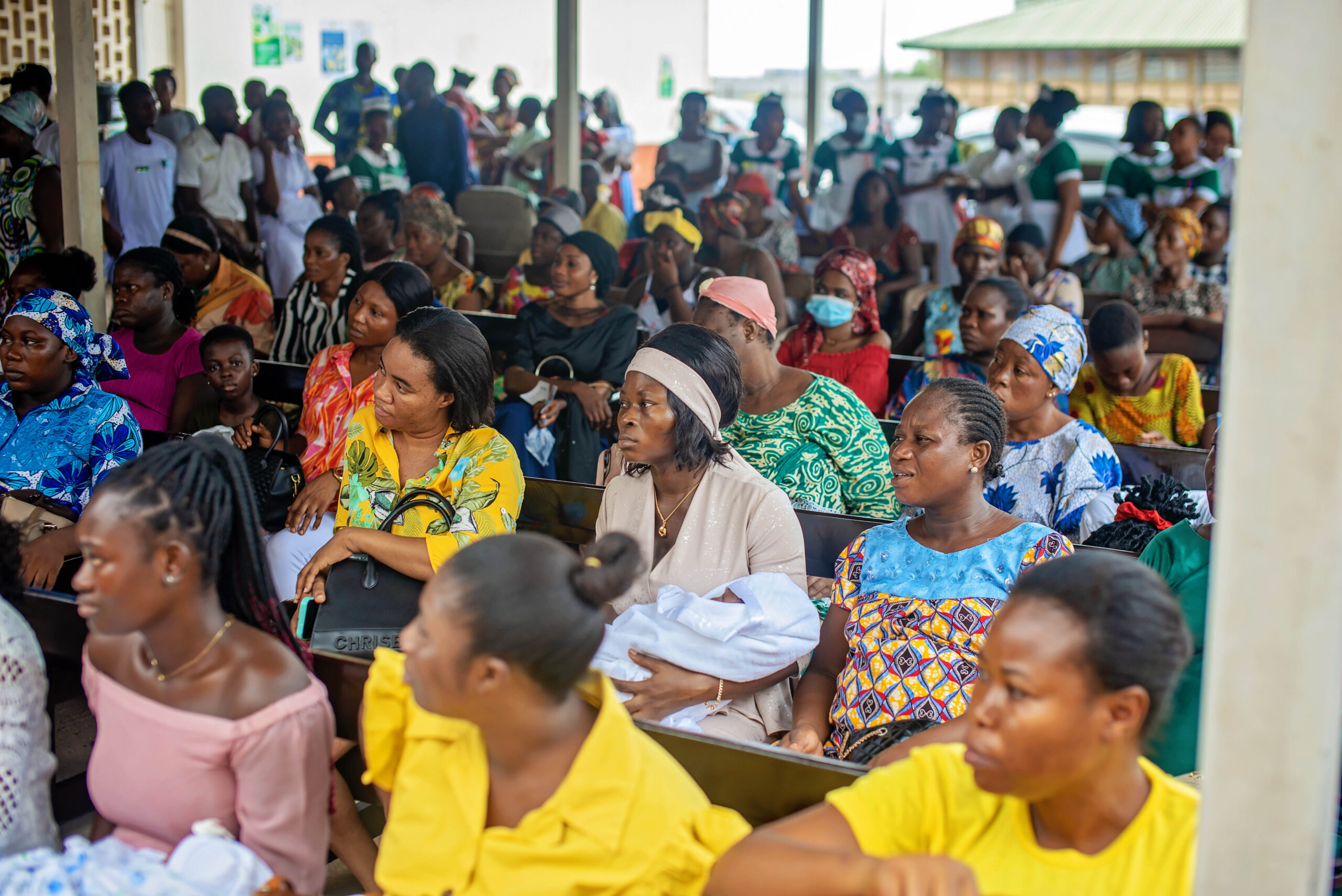
Pure Earth Ghana awareness at Greater Accra Hospital Maternal Unit
Lead exposure remains a pervasive and underappreciated threat to child health globally. Although the phase-out of leaded petrol reduced ambient exposure, many children in low- and middle-income countries (LMICs) still face risks from informal battery recycling, contaminated soils, unsafe cookware, lead-soldered pipes, and consumer products such as paints and cosmetics. Recent estimates from the Institute for Health Metrics and Evaluation suggest that nearly one in three children worldwide has blood lead levels (BLLs) above 5 μg/dL, a threshold once used as a clinical action level in the USA. Sub-Saharan Africa carries a disproportionate share of this burden, yet few countries maintain systematic surveillance of BLLs in children.
Ghana exemplifies this gap. The country has reduced maternal and child mortality through integrated reproductive, maternal, newborn, child, and adolescent health and nutrition (RMNCAH-N) strategies. These strategies underline the Maternal and Child Health (MCH) policy framework, which prioritises equity, prevention, and community-based delivery of essential services. However, Ghana’s MCH policy does not explicitly recognise environmental determinants such as heavy metal exposure. The recently developed Considerations for Planning Childhood Blood Lead Surveillance guidance (2023) from Vital Strategies provides a detailed technical roadmap for establishing surveillance systems that measure exposure, identify hotspots, and inform remediation.
This commentary analyses areas of convergence and divergence between Ghana’s MCH policy and the Vital Strategies surveillance guidance across three dimensions: policy alignment, programmatic integration, and operational synergies. I argue that bridging these frameworks would institutionalise blood lead surveillance and advance child health, equity, and sustainable development.
Policy alignment
Ghana’s MCH policy focuses on preventable morbidity and mortality. It targets neonatal deaths, under-five mortality, malnutrition, and anaemia, and promotes universal access to antenatal care, skilled delivery, and child welfare services. The surveillance guidance, meanwhile, defines BLL monitoring as a critical preventive tool to identify exposure pathways, quantify prevalence, and evaluate interventions. The frameworks converge on the population of greatest concern: children under five and pregnant women, the groups most vulnerable to the neurodevelopmental, cognitive, and haematological impacts from lead exposure.
The policies also converge on equity principles. Ghana’s MCH framework seeks to reduce health disparities across socioeconomic groups and geographic regions. Lead exposure, as demonstrated in other LMIC contexts, disproportionately affects children in poor households, peri-urban communities, and artisanal mining areas. Surveillance supports the MCH agenda by revealing inequities in environmental risk.
However, key gaps exist. The MCH policy does not reference environmental toxicants. This reflects a long-standing focus of maternal and child health programmes in LMICs on infectious diseases and nutritional deficiencies. The surveillance guidance, in contrast, centres environmental exposure science, including representative sampling, laboratory methods (e.g., inductively coupled plasma mass spectrometry, atomic absorption spectrometry), and surveillance as an “early warning system” for toxicological hazards.
The implication is clear. The MCH policy provides the normative and institutional platform. The surveillance framework provides the technical architecture. Aligning the two requires reframing maternal and child health not only as a clinical and behavioural agenda, but also to include environmental determinants of health.
Programmatic integration
Operationally, Ghana’s MCH system ranks top among its peers around the world. It includes Child Welfare Clinics (CWCs) and the Expanded Programme on Immunization (EPI), which provides near-universal contact with children under five. Antenatal and postnatal services routinely involve blood collection for haemoglobin, malaria, and HIV testing. The Community-based Health Planning and Services (CHPS) programme deploys nurses and community health officers across rural Ghana and provides an established platform for outreach and service delivery.
These service points offer entry points for blood lead surveillance. Capillary blood sampling for BLLs can be integrated into CWCs, antenatal clinics, and CHPS outreach, using portable point-of-care devices such as the Lead Care analyser. This approach aligns with the guidance to leverage existing health surveys and service contacts to reduce marginal costs.
At the population level, Ghana routinely conducts Demographic and Health Surveys (DHS), Multiple Indicator Cluster Surveys (MICS), and national nutrition surveys. The surveillance guidance recommends “piggybacking” onto such nationally representative surveys to generate baseline BLL prevalence. This would allow Ghana to generate nationally representative data without building parallel systems.
Nevertheless, the programme scope still differs from the MCH framework lacks provisions for laboratory capacity development, quality assurance protocols, and environmental exposure assessments, which are central to the surveillance guidance. For example, the guidance highlights the need for dual-tier testing, with capillary screening followed by venous confirmation, proficiency testing of laboratories, and integration of environmental sampling (e.g., soil, dust, water, cookware) with child BLL results. These dimensions extend beyond current MCH services.
Programmatic integration, therefore, requires a two-tier strategy: (1) embed surveillance into existing MCH platforms for routine screening and representative coverage, and (2) strengthen laboratory and environmental health capacity to generate high-quality data for policy and intervention.
Operational synergies
The MCH and surveillance frameworks align on ethics, counselling, and referral. The surveillance guidance emphasises informed consent, confidentiality, and case management protocols for children with elevated BLLs, including referral for clinical management or chelation therapy when indicated. Ghana’s MCH policy promotes the importance of patient-centred care, respect for rights, and referral across CHPS, district hospitals, and teaching hospitals. Embedding lead exposure management into this chain would support continuity of care.
Workforce synergies are evident as well. The guidance recommends mobilising local health workers, nurses, and health science students for sample collection and testing. Ghana’s CHPS programme already deploys nurses at the community level, who can be trained in capillary sampling and the use of portable BLL analysers. This would extend CHPS from traditional maternal-child health to environmental health monitoring, without creating a parallel workforce.
Health information systems present another synergy. Ghana’s District Health Information Management System (DHIMS2) is a national repository for routine health data. Integrating BLL indicators into DHIMS2 aligns with the surveillance guidance on unique identifiers, electronic data capture, and linkage with environmental databases. ⁷ This would make BLL data visible to policymakers and health managers alongside other child health indicators, promoting institutionalisation and accountability.
Proposed DHIMS2 indicator set for blood lead surveillance
- Children screened for blood lead, number and percentage, by age group 6-23 months, 24-59 months, and 5-9 years.
- Children with screen-positive capillary result, number and percentage, using a programme-defined threshold, for example, 3.5 μg/dL.
- Children receiving venous confirmation within 30 days after a positive screen, number and percentage.
- Median and interquartile range of confirmed venous blood lead by district.
- Households that received an environmental assessment after a confirmed elevated result, number, and percentage.
- Referrals issued to the Environmental Protection Authority or local authorities for remediation, number issued, and number completed.
The surveillance guidance also expands the stakeholder map to include environmental regulators, the Environmental Protection Authority, Ghana Standards Authority, and civil society groups such as Pure Earth and UNICEF. Ghana’s MCH policy is health-sector oriented. Expanding MCH governance to include multisectoral environmental health partners will strengthen surveillance and response.
Global lessons and Ghana’s opportunity
Several LMICs have piloted various models of blood lead surveillance. Peru established a nationally representative active surveillance system that included paired neurodevelopmental assessments and environmental sampling. India (Bihar and Tamil Nadu) used statewide household surveys to integrate BLL testing. The Philippines paired surveillance with national nutrition surveys. These experiences suggest that surveillance is feasible and scalable in resource-limited settings, particularly when integrated into existing platforms.
Institutionalising blood lead surveillance would position Ghana to lead on environmental child health in the region. The initiative aligns with Sustainable Development Goal (SDG) 3 (health and wellbeing), SDG 6 (clean water and sanitation), and SDG 12 (responsible consumption and production). The surveillance system would also generate actionable data for the EPA to target remediation in hotspots such as informal battery recycling clusters and artisanal mining communities.
Recommendations
I propose three strategic actions for Ghana:
- Expand policy framing: Revise the MCH/RMNCAH-N strategy to explicitly include environmental determinants of maternal and child health, beginning with lead exposure. This will elevate environmental health within the child survival agenda.
- Institutionalise surveillance: Pilot BLL screening in Child Welfare Clinics and antenatal clinics in high-risk districts and add BLL measurement to upcoming national nutrition or DHS surveys to establish a representative baseline. Use a dual-tier model, with capillary screening with portable devices, followed by venous confirmation in accredited laboratories. Provide immediate counselling after a positive screen, enter the case in DHIMS2, complete venous confirmation within 30 days, trigger a home environmental assessment for confirmed cases, and issue remediation referrals when a likely source is identified.
- Strengthen operational synergies: Add a DHIMS2 module for BLL indicators listed in the list above, enable unique child identifiers, and link records to environmental sampling results. Designate a national reference laboratory for confirmatory testing, enrol in external proficiency testing, adopt standard operating procedures for capillary collection, contamination control, and transport, and run 5 percent duplicate capillary samples for internal quality checks. Deliver a two-day training module for CHPS and Child Welfare Clinic nurses on capillary sampling, device operation, contamination prevention, counselling, and data entry, followed by a one-day refresher every six months with competency checks and corrective action plans. Standardise a counselling script for caregivers after a positive screen with exposure reduction steps for cookware, dust control, and water sources while awaiting confirmation, and refer confirmed cases to district hospitals for clinical assessment and to the EPA for environmental follow-up. Establish a joint MoH–EPA technical working group, publish monthly dashboards and quarterly briefs, and allocate a budget for devices and consumables, confirmatory testing, transport, training, quality assurance, environmental assessments, DHIMS2 updates, and communications. This approach integrates surveillance into existing systems and builds cross-sector governance.
Lead exposure represents a silent but profound threat to Ghana’s children through neurodevelopmental loss, perpetuating cycles of poverty, and eroding national human capital. The Ghana MCH policy provides a ready-made platform for surveillance delivery. The 2023 guidance offers a technical blueprint. Aligning these frameworks through policy, programmatic, and operational integration would build a credible national system for environmental child health surveillance. The time to act is now, because without surveillance, lead remains invisible, and with surveillance, Ghana can chart a path towards prevention, equity, and healthier futures for its children.
Authored by
Benjamin S. Cheabu
Technical Manager
Pure Earth Ghana.