

Pure Earth’s Innovation Lab team recently published a comprehensive literature review on the sources of lead poisoning in the journal of Science of the Total Environment, with support from co-authors Bjorn Larsen, Howard Hu and Bruce Lanphear. Available here. This review addressed key knowledge gaps on the sources of lead poisoning, revealing pathways for effective interventions.
Lead poisoning is one of the most pervasive yet under-researched global health crises, estimated to cause up to 5.5 million preventable deaths a year, more than HIV/AIDS (630,000) and Malaria (600,000) combined. It also causes the loss of around 765 million IQ points per year, representing economic losses of more than 10% of GDP in many low and middle-income countries – a significant hindrance to economic development.
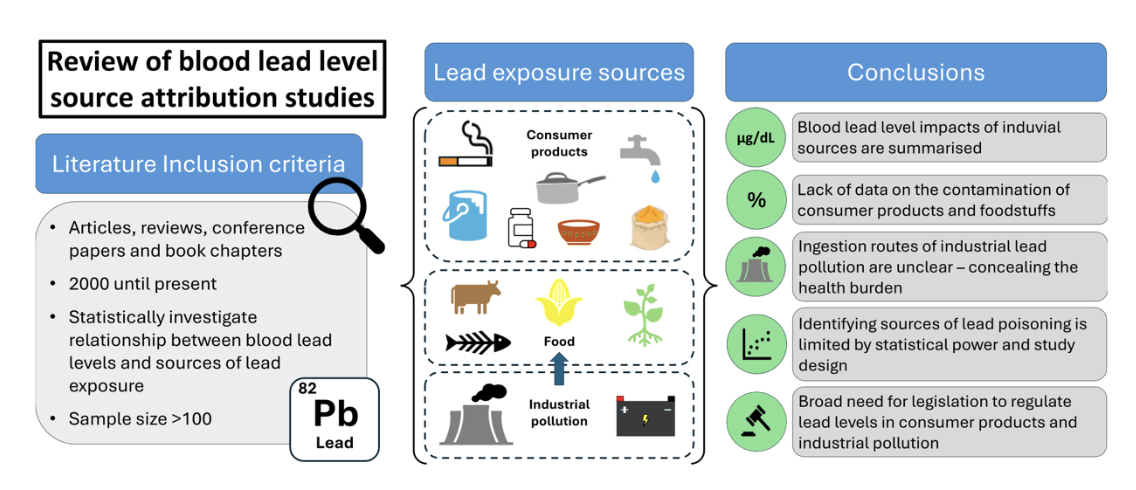
Despite this staggering toll, the sources of exposure remain poorly understood. While blood tests measure how much lead is in the body, it remains far harder to trace where that lead is coming from to prevent further poisoning. To close that gap, Pure Earth’s Innovation Lab conducted a comprehensive literature review, recently published in Science of the Total Environment.
The review confirms major sources–industrial hotspots, paint, spices, traditional cosmetics and medicines, and metal and ceramic cookware–while also revealing underresearched contributors: staple foods and smoking. These findings highlight urgent priority areas for policymakers, researchers, and funders working to reduce the global lead burden.
The Importance of Understanding the Sources of Lead Poisoning
Interventions to reduce lead poisoning are one of the most cost-effective means of improving public health, gaining increasing philanthropic support. However, the reality of public health in low- and middle-income countries is that, amongst competing priorities, resources for lead interventions are still very limited. To successfully reduce lead poisoning, we need to know the key lead sources in each country, develop streamlined interventions targeting specific lead sources, and prove the impact of these interventions by quantifying the public health benefit to gain funding and political will.
Our new paper is a big step towards quantifying health burdens from lead sources, reviewing all the disaggregated information we could find on individual lead sources. Our paper defines the key sources of lead poisoning, reviews the recorded blood lead level impact of each lead source, outlines a research agenda to quantify health burdens of lead sources, and reviews previous shortcomings and necessary criteria for designing studies to detect sources of lead poisoning within populations.
What We Found
We used a systematic approach, aiming to find all studies participants that investigated the relationship between blood lead levels and sources and blood lead levels, conducted since phase out of leaded gasoline and with sample sizes >100. The review shows that there are many sources of lead exposure with significant variation between regions and cultures, reinforcing the importance of specific national intervention strategies. Many of the lead sources that Pure Earth is already working to address were confirmed as key sources: hotspots, paint, spices, traditional cosmetics and medicines, and metal and ceramic cookware.
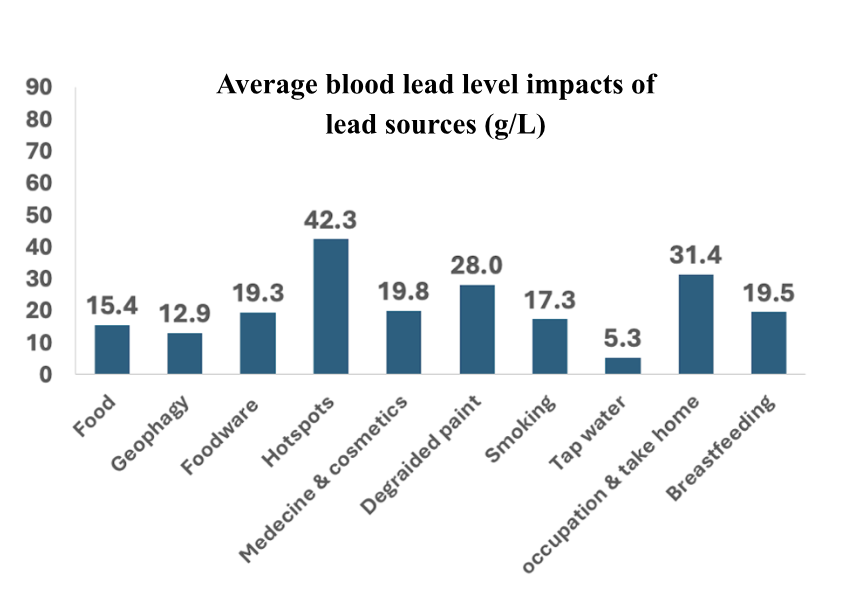
- Hotspots: Expectedly, living near industrial hotspots for environmental lead pollution showed the highest blood lead level impacts in the reviewed studies. Since the phase out of leaded gasoline, the lead acid battery industry is the single greatest source of environmental lead pollution, releasing hundreds of thousands of tonnes of lead pollution per year, contaminating air, soil, water and food crops. However, the pathways for the ingestion of industrial lead pollution have still not been quantified; it’s unclear how far lead pollution travels, how many people are exposed and what resulting level of lead poisoning they experience. We believe that the health burden from industrial pollution is currently significantly underestimated. Academic research is needed to answer these questions and uncover the health burden, to motivate the expensive, complicated yet absolutely necessary interventions.
- Paint: Lead is used as a colour pigment and to improve finish. As the paint degrades, lead sheds to dust and soil, posing a risk through inhalation and hand-to-mouth practices, especially concerning for children. The burden from paint is complicated to accurately model, but we know it’s a key source. Meanwhile, interventions are relatively cheap and there has been great regulatory progress in many countries, largely driven by our friends at LEEP.
- Spices: Turmeric is the main culprit, often deliberately adulterated with lead containing yellow pigments to improve appearance. We occasionally see lead in other spices too, but other routes of contamination are still unclear.
- Traditional cosmetics: Traditional eyeliners such as kohl, kajal, surma are often made from galena, a lead sulphide ore, and can be more than 50% lead. Ingesting only trace amounts of these products through cross contamination and hand to mouth practices can cause significant harm. Lead is often found in other products, like skin lightening creams, although this may be less common, or at least has been researched less.
- Traditional medicines: Certain categories of traditional medicines (ayurvedic medicine and traditional Chinese medicine) have been flagged as often containing very high lead levels, but research on their blood lead impacts is sparse. What we do know is that there are many hospital case reports documenting severe and even fatal lead poisoning from traditional medicines in the US – where traditional medicine use is low, but blood lead surveillance is high. Therefore, health burdens from traditional medicines are very likely high in India and China, where these practices are largely concentrated. Surveying lead concentrations in medicines would significantly improve our understanding of the health burden.
- Metal cookware: Aluminium cookware produced informally or using informally recycled aluminium commonly contains high levels of lead and are used by a substantial fraction of the global population. Lead has been shown to be released from such aluminium cookware under aggressive conditions (boiling strong acid). However, it’s still unclear how much lead is released under normal cooking conditions. Even very small amounts of lead being released would imply a substantial cumulative health burden. We’re following up on this in our cookware working group with lab testing and investigating opportunities to remove lead from cookware supply chains.
- Ceramic cookware: Lead is commonly used in ceramic glazes, and can be released into foods if the glazes are fired at low temperatures, a big concern for artisan-produced ceramics. This is a big issue in Mexico, where ceramic pottery is culturally significant and commonly artisan-produced. Rapid lead test kits would help to quickly identify dangerous, improperly fired ceramics and enable inexpensive regulatory enforcement.
- Other sources: We also review contributions from contaminated drinking water, Pica & geophagy (deliberately eating soil and other non-food items), e-waste, plastics, and firearms.
New Concerning Findings
The review also highlighted other sources of lead exposure that have received a lot less attention but are likely key contributors to the global lead poisoning health burden, in particular, staple foods and smoking.
- Staple foods: A few studies found significant blood level impacts from eating staple foods such as rice, cassava and vegetables – very concerning because most people eat these foods. It’s clear that lead contamination in food crops is a big problem. We know that plants absorb lead from soil, but it’s not clear where the lead is coming from. We suspect the contamination could be from industrial pollution, pesticides and fertilisers, irrigation water or legacy pollution from gasoline. The answer is likely all of the above, but we need to better understand the pathways for food contamination so that we can identify the populations most at risk and develop the necessary interventions and regulations.
- Smoking: Smoking has surprisingly slipped through the lead community’s net. Just like food crops, tobacco plants absorb lead from soil, which is then inhaled when you light up. Smoking is toxic, who knew! Fortunately, virtually every health study collects data on smoking. Our estimates show smoking accounts for about 10% of the global lead health burden: 7% from active smoking and 3% from passive smoking. More on quantifying health burdens from lead sources to come in future blog posts.
What Comes Next for the Innovation Lab
With the many different sources of lead exposure embedded into daily life, it can be difficult to know where to start with interventions. Pure Earth’s Innovation Lab was set up to address two questions: i) Which sources contribute the most to the global lead poisoning health burden? And, ii) Where can interventions be most effective to reduce the health burden?
There are big missing pieces to this puzzle which continue to elude the lead research community. But I honestly believe that we are making significant progress and are building pathways to answer these questions. There is still a lot of low-hanging fruit and big gains to be made by collaborating and incorporating expertise and analytical tools from other disciplines, particularly epidemiology, environmental engineering, geochemistry, isotopic analysis and atmospheric modelling.
- Food Contamination: Understanding the lead burden from food is our first priority. I’m currently doing a deep dive review, pulling all the data I can find from national diet surveys that quantify dietary lead intake. This highlights the scale of the problem and identifies the key food groups of concern. We’ve also collaborated with Columbia University’s isotopic analysis lab, the food safety organisation IFPRI and the University of Nairobi to investigate pathways of lead contamination in kale crops in Nairobi – previously highlighted to have high lead levels by IFPRI. We’ve collected samples from 15 farms and will begin our analysis soon, stay tuned!
- Cookware Leaching Tests: We know that harmful levels of lead are released from metal and ceramic cookware when boiling acid, and we’re testing plastic cookware too. Now we’re setting up tests reflecting normal cooking practices to see what the blood lead impacts are from normal use.
- Lead in Medicines, Cosmetics, and Fertilizers: Innovation Lab interns are also working on projects aimed at finding more data on lead levels in traditional medicines, cosmetics, and fertilisers, and also investigating the long-range transmission of industrial lead emission.
The Innovation Lab team will be keeping you up to date with our progress. Please don’t hesitate to reach out with any questions for the Innovation Lab at [email protected].
Learn more about Pure Earth’s Innovation Lab here.